
About bone marrow
Bone marrow is a sponge-like material found inside certain bones of the body. Blood cells are made in the bone marrow.
Blood is made up of three main types of cells: red blood cells, white blood cells and platelets.
We can assess disorders affecting any of these cell types by examining a sample of your bone marrow.
About a bone marrow biopsy
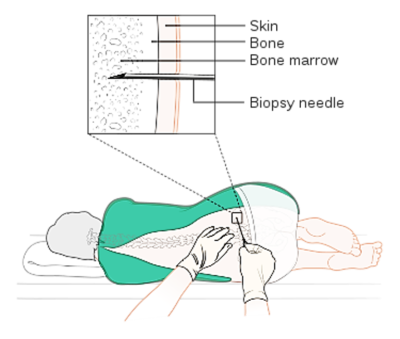
A biopsy means removing a small sample of skin, tissue or cells for testing.
To perform a bone marrow biopsy, we take a sample of bone marrow from inside your bone. We usually take this from the back of your pelvic bone.
The procedure usually takes 15 to 45 minutes. We advise you to allow 1 hour for the procedure, in case we need to take a blood sample before or after the procedure.
If you wish, you can bring someone with you to your appointment.
If you take medication
Let us know if you take any form of medication that is:
- an anticoagulant (warfarin, rivaroxaban, apixaban, edoxaban), or
- thins the blood (aspirin or clopidogrel).
Your GP will let you know whether to stop these medications before your biopsy.
If your GP has not advised you on whether to stop taking these medications, get in touch with us (see Contacts, below) before your biopsy. We can advise you on the best course of action.
On the day
You can expect the following on the day.
- We will discuss the procedure with you, and you will be able to ask questions. We will ask you to give consent for us to go ahead with the biopsy.
- You can wear your own clothes. We will not ask you to wear a hospital gown.
- We will ask you to lie on your side with your knees bent up. We will loosen your clothing to expose your back at the top of your pelvic bone.
- We will clean your skin with antiseptic solution.
How it feels
- We will inject you with local anaesthetic, in the skin over the back of your pelvic bone. This will numb the area where we take the sample.
- You may feel a stinging sensation before your skin starts to feel numb.
- Some patients experience a sharp pain (lasting a few seconds) as we draw the bone marrow into the syringe. If we use a second needle, you may experience an aching sensation afterwards.
- Some patients feel a tingling sensation in their leg during the procedure.
Taking the sample
- When the needle site area is numb, we will pass a needle through your skin and into your bone. We will use a syringe to take a sample of your bone marrow.
- Sometimes we use a second needle, to take a sample of the more solid bone marrow tissue.
- When we have finished, we will place a small dressing over the wound site.
- We will ask you to stay lying on the bed for a few minutes, to recover and prevent further bleeding from the wound.
Risks
- There is a small risk of bleeding from the wound site.
- There is a small risk that the wound site may become infected afterwards.
Afterwards
It is usual to see a small amount of blood on the dressing. If this happens, apply light pressure to the area. If needed, we will give you a spare dressing to take home.
It is usual to feel a bruised or aching sensation in the wound area. You can take over-the-counter pain medication to relieve this.
When you have fully recovered, you will be free to leave.
- You can eat and drink normally. We can provide refreshments.
- You can visit the toilet.
- You can drive yourself home.
- Avoid heavy exercise for 48 hours after the biopsy.
| Keep the wound dressing dry for 24 hours. This will prevent infection. You can shower and swim as usual after 24 hours, and will not need a further wound dressing. |
When to seek medical help
If bleeding continues after 24 hours, get in touch with the Kingston Hospital Haematology Department (see Contacts below).
Results
We usually give patients their test results at their next clinic appointment.
Contact information
Maxwell Thorne Haematology Day Unit
Level 2, Sir William Rous Unit
Monday to Friday, 9pm to 5pm